
When Nigerian university students discuss academic performance, two terms that come up frequently are Second Class Upper (2:1) and Second Class Lower (2:2). Both are recognized honors degree classifications and are determined mainly by a student’s final Cumulative Grade Point Average (CGPA).
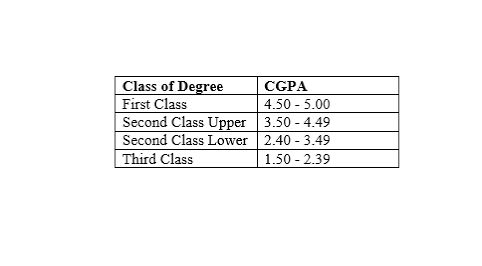
Under the 5-point grading system commonly used by Nigerian universities, Second Class Upper generally covers a CGPA of 3.50 to 4.49, while Second Class Lower covers 2.40 to 3.49.
The difference between the two classifications can influence access to certain jobs, postgraduate programmes and scholarships. However, individual universities may have slightly different grading policies, so students should always check their institution’s academic regulations.
This article explains what Second Class Upper and Second Class Lower mean in Nigeria, their CGPA ranges, how CGPA is calculated, and what each classification may mean for employment and further education.
Nigerian University Degree Classification System
Most federal and state universities in Nigeria operate a 5.0 CGPA grading system. Many private universities also follow this structure, although some institutions make minor adjustments to their classification boundaries.
A commonly used degree classification system is:
| Degree Classification | CGPA Range |
| First Class Honors | 4.50 – 5.00 |
| Second Class Upper | 3.50 – 4.49 |
| Second Class Lower | 2.40 – 3.49 |
| Third Class Honors | 1.50 – 2.39 |
| Pass | 1.00 – 1.49 |
| Fail | Below 1.00 |
Some universities no longer award Pass degrees, while others may set Second Class Lower at 2.50 rather than 2.40. For this reason, the official handbook or Senate regulations of a university should be treated as the final authority.
What Is Second Class Upper in Nigeria?
A Second Class Upper degree, commonly called 2:1, is the classification immediately below First Class.
On the widely used 5-point scale, students generally need a final CGPA between 3.50 and 4.49 to graduate with Second Class Upper.
For example, a student with a final CGPA of 3.50 qualifies for 2:1. A graduate with 4.49 also remains in the Second Class Upper category because First Class normally begins from 4.50.
Students within this range often have a strong combination of A and B grades throughout their studies.
A 2:1 is frequently preferred for competitive graduate recruitment programmes, scholarships and postgraduate admission. However, it does not automatically guarantee a job or admission because other requirements may also apply.
What Is Second Class Lower in Nigeria?
A Second Class Lower degree, commonly called 2:2, is the honors classification immediately below Second Class Upper.
The commonly used CGPA range is 2.40 to 3.49 on the 5-point scale.
This means a student graduating with 2.40, 2.80, 3.00 or 3.49 would normally receive a Second Class Lower degree. Once the student’s CGPA reaches 3.50, the classification moves into Second Class Upper.
A 2:2 is a full honors degree. Graduates with this classification can apply for many jobs, professional qualifications and postgraduate programmes.
Some institutions, particularly private universities, may use slightly different boundaries. Students should therefore avoid assuming that the same CGPA classifications apply in every university.
Second Class Upper vs Second Class Lower
The key difference between 2:1 and 2:2 is the final CGPA.
| Feature | Second Class Upper (2:1) | Second Class Lower (2:2) |
| CGPA Range | 3.50 – 4.49 | 2.40 – 3.49 |
| Academic position | Below First Class | Below Second Class Upper |
| Typical grades | Mainly A and B | Mainly B and C |
| Graduate jobs | Often preferred for competitive roles | Accepted by many employers |
| Postgraduate study | Widely accepted | Accepted by many programmes |
| NYSC eligibility | Eligible | Eligible |
One important point is the boundary between 3.49 and 3.50. A final CGPA of 3.49 is still Second Class Lower, while 3.50 qualifies as Second Class Upper.
How the Nigerian University Grading System Works
A typical 5-point grading scale awards grade points according to the student’s score in each course.
| Score | Grade | Grade Point |
| 70–100 | A | 5.00 |
| 60–69 | B | 4.00 |
| 50–59 | C | 3.00 |
| 45–49 | D | 2.00 |
| 40–44 | E | 1.00 |
| Below 40 | F | 0.00 |
These ranges are common but can vary. Some universities, for example, may require 75% for an A or set the minimum passing mark at 45%.
How To Calculate CGPA
CGPA measures a student’s cumulative academic performance.
The basic formula is:
CGPA = Total Quality Points ÷ Total Credit Units Attempted
Quality points are obtained by multiplying the grade point earned in a course by the number of credit units assigned to that course.
Suppose a student scores 72% in a 3-unit course. If this gives an A with 5 grade points:
5 × 3 = 15 quality points
If the same student earns a C, worth 3 grade points, in a 2-unit course:
3 × 2 = 6 quality points
The quality points from all courses are added together and divided by the total credit units attempted.
Because CGPA is cumulative, academic performance from different semesters contributes to the final degree classification.
Does Second Class Upper Give Better Job Opportunities?
A Second Class Upper can provide an advantage when applying for some competitive graduate jobs.
Certain banks, consulting companies, telecommunications firms, oil and gas companies and multinational organizations may use 2:1 as an initial academic requirement for graduate recruitment.
However, not every employer requires Second Class Upper.
Employers may also consider professional skills, internships, work experience, communication ability, technical knowledge and performance during interviews.
As graduates gain experience, their practical achievements and professional qualifications may become more important than their original degree classification.
Can a Second Class Lower Graduate Get a Good Job?
Yes. A graduate with Second Class Lower can get a good job.
Many employers in both the private and public sectors accept candidates with 2:2 degrees. Graduates can also improve their competitiveness by acquiring additional skills and professional qualifications.
Useful areas for development include digital skills, industry certifications, project experience, internships, communication skills and technical training.
A 2:2 should therefore not be viewed as the end of a graduate’s career opportunities.
Can a 2:2 Graduate Do a Master’s Degree?
Many universities accept Second Class Lower graduates for master’s programmes, although requirements vary by institution and course.
Some programmes may admit applicants with 2:2 directly, while more competitive programmes may require 2:1.
In some situations, an applicant may be required to complete a Postgraduate Diploma (PGD) before progressing to a master’s degree.
Relevant work experience and professional qualifications may also strengthen an application.
Does Degree Classification Affect NYSC?
Both Second Class Upper and Second Class Lower graduates can qualify for National Youth Service Corps (NYSC) mobilization as long as they meet the applicable eligibility conditions.
Degree classification itself does not normally determine whether a graduate can participate in NYSC.
Can a Student Move From 2:2 to 2:1?
A student who has not yet graduated may be able to improve from Second Class Lower to Second Class Upper.
The possibility depends on the student’s current CGPA, the number of credit units already completed and how many courses remain.
Students trying to improve their CGPA should pay particular attention to high-credit courses, aim for more A and B grades, avoid failing courses and monitor their CGPA after every semester.
The earlier a student begins improving academic performance, the greater the opportunity to raise the final CGPA.
Career Outlook and Final Thoughts
Second Class Upper and Second Class Lower are two of the main honors degree classifications in Nigerian universities. Under the commonly used 5-point grading system, Second Class Upper ranges from 3.50 to 4.49, while Second Class Lower ranges from 2.40 to 3.49.
A 2:1 may provide an advantage for some competitive jobs, scholarships and postgraduate programmes, while a 2:2 remains a recognized honors degree with access to many career and further-study opportunities.
Students should understand how their CGPA is calculated, monitor their academic performance regularly and confirm the exact grading policy used by their university. Beyond the degree classification itself, developing practical skills, professional experience and relevant qualifications can play an equally important role in long-term career success.
Leave a Reply