
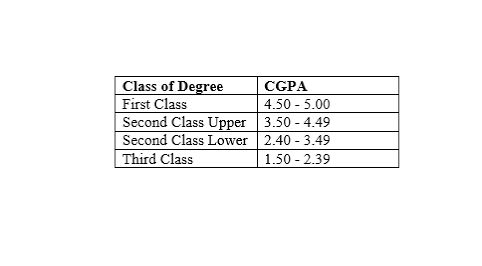
A First Class Honours degree is the highest undergraduate degree classification awarded by Nigerian universities. On the 5-point grading scale widely used across the country, a student generally needs a final Cumulative Grade Point Average (CGPA) of 4.50 to 5.00 to graduate with First Class.
This means that a student who finishes with a CGPA of 4.50 or above qualifies for First Class, while a student with 4.49 remains in the Second Class Upper category under the standard classification.
Earning First Class requires more than performing well in a few examinations. Since CGPA reflects academic performance across an entire university programme, students usually need to maintain consistently high grades from their first year until graduation.
This article explains the CGPA required for First Class in Nigeria, the grading system, how CGPA is calculated, the grades needed to maintain a First Class, and practical steps students can take to graduate with First Class Honours.
What CGPA Is First Class in Nigeria?
Under the 5.0 grading scale commonly used by Nigerian universities, the First Class CGPA range is 4.50 to 5.00.
The commonly used degree classification is shown below:
| Degree Classification | CGPA Range |
| First Class Honours | 4.50 – 5.00 |
| Second Class Upper (2:1) | 3.50 – 4.49 |
| Second Class Lower (2:2) | 2.40 – 3.49 |
| Third Class | 1.50 – 2.39 |
| Pass | 1.00 – 1.49 |
Some universities no longer award a Pass degree and may require students to maintain a minimum CGPA of 1.50 or meet other academic requirements to remain in their programme.
Individual institutions can also have slightly different grading rules, so students should check their university’s official academic handbook or Senate-approved regulations.
Is 4.50 the Minimum CGPA for First Class?
Yes. Under the widely used Nigerian university 5-point system, 4.50 is generally the minimum CGPA required for a First Class degree.
A final CGPA of:
4.49 = Second Class Upper
4.50 = First Class
5.00 = First Class
Although the difference between 4.49 and 4.50 is only 0.01, it crosses the normal boundary between Second Class Upper and First Class.
Students should not assume that a 4.49 will automatically be rounded to 4.50. Any rounding or borderline policy depends on the academic regulations of the particular university.
What Grades Do You Need to Graduate With First Class?
A student aiming for First Class must generally earn a large number of A grades, together with a limited number of B grades.
A typical Nigerian university grading scale looks like this:
| Percentage Score | Grade | Grade Point |
| 70–100 | A | 5.00 |
| 60–69 | B | 4.00 |
| 50–59 | C | 3.00 |
| 45–49 | D | 2.00 |
| 40–44 | E | 1.00 |
| Below 40 | F | 0.00 |
Because the minimum First Class CGPA is 4.50, a student cannot rely mainly on B grades. A B carries 4 points, which is below the First Class average.
The student therefore needs enough A grades, worth 5 points each, to keep the overall CGPA at or above 4.50.
A few universities use different percentage boundaries, including institutions where an A may begin from 75%. Students should therefore work with the grading scale approved by their own university.
How Is CGPA Calculated?
CGPA is calculated from the quality points earned in all courses and the total credit units attempted.
The basic formula is:
CGPA = Total Quality Points ÷ Total Credit Units Attempted
The quality point for an individual course is:
Grade Point × Credit Unit
For example, suppose a student earns an A in a 3-credit-unit course.
Since an A carries 5 grade points:
5 × 3 = 15 quality points
If the student earns a B in another 3-unit course:
4 × 3 = 12 quality points
The university adds the quality points earned from all applicable courses and divides them by the total credit units to calculate the student’s GPA or cumulative CGPA.
This also explains why high-credit courses can have a greater impact on CGPA than courses carrying fewer units.
Why Is It Difficult to Graduate With First Class?
Maintaining a minimum average of 4.50 over several academic sessions requires a high level of consistency.
A few B grades may not prevent a student from graduating with First Class. However, repeated Cs, Ds or failed courses can significantly reduce the CGPA.
For example, a C carries only 3 grade points. If it is earned in a high-credit course, other strong results may be needed to compensate for its effect on the overall average.
The cumulative nature of CGPA also means that poor academic performance in earlier years can continue to affect the final result.
This is why students hoping to graduate with First Class should begin working towards the target from their first year rather than waiting until final year.
How to Graduate With First Class in a Nigerian University
Graduating with First Class requires good academic ability, but effective planning and consistency are equally important.
Start Strong From 100 Level
The grades earned during the first year contribute to the cumulative academic record. A strong foundation makes maintaining a high CGPA easier in later years.
Recovering from a very low first-year CGPA may be mathematically possible, but it usually requires exceptionally strong performance in the remaining semesters.
Aim for an A in Every Course
Students targeting First Class should approach A grades as their main objective rather than something optional.
A B is a strong grade, but it carries only 4 points. Since First Class requires an average of at least 4.50, enough A grades are needed to balance every B.
Pay Attention to High-Credit Courses
A poor grade in a 4-unit course generally affects the GPA more than the same grade in a 1-unit course.
Students should therefore identify high-credit courses and give them the preparation they require.
Maximise Continuous Assessment
Continuous assessment may include tests, assignments, presentations, practical work and other assessments.
Where continuous assessment contributes 30% of the final score, performing strongly in this component can provide an important advantage before the main examination.
Students should avoid unnecessarily losing marks through missed assignments, poor attendance or inadequate preparation for tests.
Avoid Failed Courses
An F carries zero grade points and can severely affect a student’s CGPA, particularly when the failed course has several credit units.
Students aiming for First Class should seek help early when they are struggling with a course rather than waiting until examination periods.
Monitor Your CGPA Every Semester
Students should know their current academic standing.
Calculating GPA and CGPA after each semester makes it easier to determine whether performance is improving or declining.
It also allows a student to estimate the grades required in future semesters to maintain or reach the First Class threshold.
Can You Still Graduate With First Class After Getting a B?
Yes.
A student does not need straight A grades in every course to graduate with First Class.
A limited number of B grades can still result in a CGPA of 4.50 or above, provided the student earns enough A grades to maintain the required average.
For example, a student whose results consist mostly of As with a smaller number of Bs may still comfortably remain within the First Class range.
The exact number of Bs a student can afford depends on the credit units attached to those courses and the grades earned in the rest of the programme.
Can You Graduate With First Class After Getting a C?
Yes, it can still be mathematically possible.
However, a C has a grade point of 3.00 and therefore pulls the average further below the First Class threshold than a B.
Its impact becomes more significant if the course carries several credit units.
A student who receives one or more C grades may need many strong A grades in other courses to compensate.
The possibility of recovering will depend on the student’s existing CGPA and the number of credit units remaining before graduation.
How Rare Is a First Class Degree in Nigeria?
First Class graduates generally represent a minority of each graduating class, although the percentage differs considerably between universities and from one graduation year to another.
Some public universities report relatively small percentages of First Class graduates, while some private universities have recorded larger proportions.
Differences can reflect numerous factors, including student population, academic support systems, programme structure, admission standards, institutional policies and learning environments.
A perfect 5.00 CGPA is much rarer because it requires an exceptionally high level of academic performance across virtually all applicable courses.
Is First Class the Same in Every Nigerian University?
The 4.50 to 5.00 First Class range is widely used by Nigerian universities operating the 5-point grading system, but not every institution has identical academic regulations.
Differences may occur in areas such as:
- The percentage required for an A
- Minimum passing grades
- Treatment of repeated courses
- Carry-over policies
- Rounding of final CGPA
- Programme-specific graduation requirements
Students should therefore always confirm the exact rules of their own institution instead of depending solely on general national grading information.
What Are the Benefits of Graduating With First Class?
A First Class degree can create additional opportunities after graduation.
It may strengthen applications for competitive:
- Graduate employment programmes
- Postgraduate admission
- Academic and research positions
- Graduate assistantships
- Scholarships and fellowships
It also provides a strong academic record when applying to universities outside Nigeria.
However, First Class does not guarantee employment, scholarships or admission. Employers and universities may also consider skills, experience, research ability, recommendations, entrance tests and other requirements.
First Class Degree and International GPA Conversion
Nigerian graduates applying to universities abroad may be asked to submit their transcripts for credential evaluation.
It is tempting to convert a Nigerian CGPA directly from the 5.0 scale to a US 4.0 scale, but a simple mathematical conversion is not always reliable.
International universities and credential evaluation organisations may assess academic records course by course, considering the institution’s grading system, individual grades and credit units.
A Nigerian First Class degree is generally regarded as a strong academic qualification, but applicants should rely on the assessment method required by the institution to which they are applying.
Final Thoughts
A First Class degree in Nigeria generally requires a final CGPA between 4.50 and 5.00 on the widely used 5-point grading scale. Achieving it requires consistent academic performance, with A grades forming the majority of a student’s results.
Students who want to graduate with First Class should begin working towards the target early, pay close attention to high-credit courses, maximise continuous assessment scores, avoid failed courses and monitor their CGPA after every semester.
While First Class can provide an advantage when applying for competitive jobs, postgraduate programmes and scholarships, students should also develop practical skills, professional experience and other qualities that contribute to long-term career success.
Above all, students should check their university’s official academic regulations because grading details, rounding policies and programme requirements may differ slightly between institutions.
Leave a Reply